

Updated research has shown up lingering headaches over the impacts of decades-long nuclear testing in the Pacific islands and interventions of outside powers, amid growing threats from climate change, writesDr Lee Duffield.
THE JOURNALIST, Professor and peace activistDavid Robie, was one of a media party on the ill-fated voyage of the Greenpeace shipRainbow Warrior(1955), in 1985, before its sinking by French security operatives in Auckland Harbour. He wrote a definitive book about the lead-up in the region to the fatal sinking of the ship with explosive mines; unmasking of the plot made in Paris; attempts to obtain justiceand a long aftermath with demands for empowerment by former colonial people, to prevent such outrages in their island homelands.
The book isEyes of Fire, published in 1986, then successively updated as the story unfolded, with new facts and consequences of the outrage coming to light. It ran to three revised editions, the last out now to commemorate 40 years since the attack took place. It therefore marked 40 years since the death of the Greenpeace photographerFernando Pereira, a Portuguese-born Dutch national, aged 35, father of one child, drowned on board after the second of two blasts that hit the ship.
Eyes of Fire is a highly professional work of journalism, built out of investigation and documentation of facts, then fashioned into an accessible read; illustrated also with easy-to-comprehendmaps and diagrams, showing where the ship travelledand where the bombs were planted against its hull, plus photographs from a copious accumulation built up as the Greenpeace movement generated publicity for its actions worldwide.
VOYAGE OF THE WARRIOR
One section describes the Rainbow Warrior, appreciatively and affectionately: a former fisheries research vessel, a trawler type, 50-metres in length, with some difficulty converted for sail as well as power, made into a 'proud campaign ship', painted a strong green with a long rainbow-emblem along the sides.
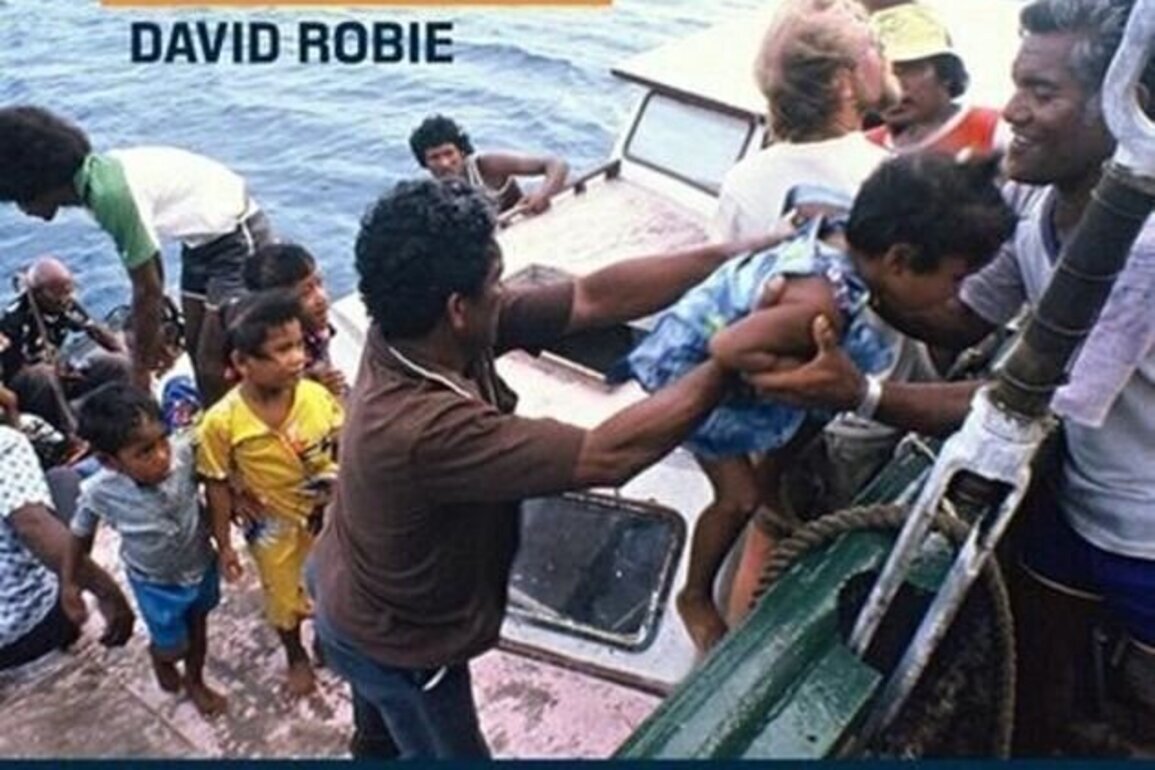
For the record...The Rainbow Warrior sailed from Hawaii taking on board seven journalists and some leading figures from the Pacific communities, to theMarshall Islandswhere it evacuated the inhabitants of a nuclear afflicted island,Rongelap, to an uninhabited islandMejattoin its archipelago. Pacific distances are great. They transported 350 people with lumber and belongings in four trips, 250-kilometres there and back. The islanders were suffering from contamination by the infamous upwind explosion of the experimental thermonuclear weapon,Castle Bravo, in 1954causing thyroid disorders, cancers and constant miscarriages and birthing disorders. Dissatisfied that health officials sent by the United States administration were more interested in research than care, they decided to leave. The key instigator was Marshall Islands legislatorSenator Jeton Anjain. He was one of two Pacific Islands leaders with prominent roles in Robies narrative.
The other wasOscar Temaru, a town mayor in Tahiti, also elected as the territorys President on five occasions.
Temaru spoke for many when he said:
A native American woman named Eyes of Fire had told a Greenpeace member about a legend, that where there was dispossessionand despoilation of the land and culture, in time mythical warriors deliverers would come, who would mend and restore both. So the peace-ship offering aid would be a Rainbow Warrior.
The author, Robie, in his news despatches for Radio New Zealand, judged the evacuation project a change for Greenpeace towards humanitarian work connected with environmental destruction:
But the next part of the journey was another dramatic action, in Marshall Islands, at the U.S. missile testing base onKwajalein Atoll. A party from the ship went ashore, got through perimeter wires and hoisted a banner inscribed Stop Star Wars onto a space tracking dome, escaping before the arrival of security guards. The banner was a reference to the AmericanStrategic Defence Initiative, Star Wars, testing for which had increased the heavy traffic of missiles of different levels at the Kwajalein range (dubbed by the empire as theRonald Reagan Ballistic Missile Defense Site).
The scene was then being set for the tragedy as the vessel made its way 5000-kilometres to Auckland through friendly territory, calling in atKiribati, the formerChristmas Islandbase forBritish nuclear tests(1957-58), andVanuatu, where the leader of the then five year-old Republic,Father Walter Lini, a champion for a nuclear free Pacific, organised a big public welcome.
THE STRIKE
Celebration fitted the mood of the Warrior crew a lot of the time, in this account;a group of eleven skilled and idealistic younger people, sharing a mission they considered important to the world, and enjoying it as an adventure. They wanted to protect nature and promote peace, never violent, but charismatic, given to direct action, often enough dangerous. They had 14 others on board in the case of David Robie, for an extended time,11 days, time enough to get to know the characters and introduce them to readers in his book.
A further leg of the voyage was intended, to take them toMururoa Atollwhere France was continuing with underground nuclear testing as flagship for a flotilla of protest boats. In the event, the flotilla sailed, led by another Greepenace ship, Greenpeace III. One boat was arrested penetrating the 12-kilometre territorial limit around the Atoll, where a series of tests wasabout to begin.
The planned disruption of activities on Mururoa may have been the death warrant for Rainbow Warrior a solution to the riddle of what purposes its destruction was supposed to serve.As the ship made its way towards Auckland , two French infiltrators got to work in that City, penetrating the Greenpeace operation. A group of military divers from a training base in Corsica was en route to New Zealand on a charter boatand two officers of Frances security service, DGSE,Dominique PrieurandAlain Mafart, flew in under cover as a honeymoon couple.
Rainbow Warrior came in on Sunday 7 July 1985, surrounded by an escort of small boatsand was sunk at the dock in shallow water just before midnight on 10 July. Divers using an inflatable boat set off the two explosions. Prieur and Mafart were spotted picking up one of the divers on a beach by men doing night watch at their boat club, who got the number of their vehicle, enabling the police to apprehend them, and begin a tortured process to try and secure justice.
Rainbow Warrior, Woodside protest (Image supplied)
AFTERMATH
Updating of the book takes in the negotiations over holding Prieur and Mafart, their eventual transfer to France and subsequent early release; the fate of other conspirators spiritedhome, promoted, decorated, looked after in early retirement; intensive and large scale work by the New Zealand police to find out about the charter boat carrying some of the divers, said to have transferred them onto a submarine, the Rubis; investigative work by the French press to sheet home responsibility for the attack.
Very soon after Rainbow Warrior was sunk, the Defence Minister,Charles Hernu, was sacked and the head of the DGSEAdmiral Pierre Lacosteresigned. The book has a positive impression of the replacement Minister,Paul Quilesand the Prime Minister,Laurent Fabius, who admitted the obvious, that it had been done by French agents, arranged financial support for the Pereira family and was apologetic. Subsequent negotiations between New Zealand and France, under United Nations auspices were made very difficult; a formal apology was avoided for some time; eventually both New Zealand and Greenpeace received financial packages in compensation and exemplary damages.
After the 1996 death ofFrancois Mitterrand, French President at the time, an investigation by Le Monde turned up circumstantial evidence that he knew of the attack in advanceand a statement by Lacoste that he had approved it. Fabius evidently had not known. Mitterrands motive was said to have been realpolitikto support nuclear deterrence against the Soviet Union in tandem with the USA, which supplied France with highly strategic computer technology.
Reviewer intercession...Mitterrand, as a highly equivocal and manipulative politician, walked a tightrope, always watching his soft electoral margins in this case knowing there was 60 per centsupport for nuclear testing in France. In office for four years in 1985, it may have been a new Government still failing to face down entrenched security identities, undisciplined, considering themselves to be deep state, attached to violent solutions, with potential to go rogue.
Most of Robies work here is a narrative, a strong true story, but it has space for analysis, and in particular registers the correlation between devastation brought by the nuclear testing,and colonial management and manipulation of islands affairs. The post-War wave of independence had come to the Pacific, though not to French Polynesia nor New Caledonia. In addition,the United States still held its Micronesian dependencies in trust or, for Sovereign states, via signed compacts of free association, accompanied by substantial aid payments. Frances position against independence is incentivised by maintaining colonies of over 100,000 settlers;and in New Caledonia, the nickel deposits, around 15% of world resources, as well as the 200 kilometre territorial zone off the long coast ofGrande Terreisland, opening onto as yet unsurveyed undersea resources. For the Americans, the priority has been both weapons testing and maintaining a strategic barrier against Russia, then China.
OLD PROBLEMS, FUTURE CHALLENGES
These considerations help to address the always unanswered questionof what the plotters thought they had to gain. The book suggests a clumsy and excessive attempt to stop the ship leading a flotilla to Mururoa Atoll as most likely. It goes on to identify same-old patterns of resistance in latter-day moves, successful, to get better recognition of the impacts of nuclear contaminationand in the moves through international forums such as the Intergovernmental Panel on Climate Change, South Pacific Forum, United Nations agencies, the international courts to get recognition and action on the impacts of climate change. Pacific communities mindful of the rising seas, and other problems like impacts on sea-life, have struggled to get a hearing, finding, again, that great powers outside the region which hold resources that can help hold off the crisis, hold back their response. Nuclear testing in the atmosphere was made to stop in 1974; tests underground on the atolls continued to 1996, leaving a very brief interregnum before global warming reared its head.
The current edition of Eyes of Fire has a prologue byHelen Clark, New Zealand Prime Minister from 1999-2008, a staunch keeper of the faith in a nuclear-free Pacific. Saying, 'storm clouds are gathering', she warns against renewed militarisation especially with Australia and perhaps other Pacific states acquiring nuclear submarines under the 2021 AUKUS agreement.
It is time for 'de-escalation, not for enthusiastic expansion of nuclear submarine fleets in the Pacific', writes Clark in her contribution to the new edition.With its peace policy, New Zealand wanted to be 'a force for diplomacy and for dialogue, not for warmongering'.
Clark warnswithdrawal of funding from the United Nations, led by the USA, is a new threat: 'Its humanitarian, development, health, human rights, political and peacekeeping, scientific and cultural arms all face fiscal crises.'
David Robie reports on the 40th anniversary commemoration of the 1985 events by Greenpeace, sending the new purpose-built ship, the new Rainbow Warrior (2011), sometimes known asRainbow Warrior III, to carry out independent radiation research. He follows up the lives and careers of the crew members and the islanders they worked with, several of whom have passed away.
While the writers own message, as in much good journalism, emerges from true handling of the facts, Robie does privilege a quotation from the executive director of Greenpeace Aotearoa,Russel Norman, on the crew of Rainbow Warrior, to close the story:
Note on the reviewer...Dr Lee Duffield reported on Australias dispute with France over atmospheric testing for ABC News in Sydneyand then from Paris as the ABC European Correspondent. His work entailed monitoring police actions against Kanak activists in New Caledonia, including the killings onOuvea Island; confrontations with French Ministers over the test program; and negotiations between France and New Zealand, in Paris, on Rainbow Warrior, especially the gaoling then early release of Dominique Prieur and Alain Mafart. He later taught Journalism at QUT in Brisbane and was a contributor to Pacific Journalism Review. Dr Duffield is also one of theowners of Independent Australia, and the chair of itsEditorial Board.
Rainbow Warrior, Fremantle (Image: supplied)
Related Articles
- JEFF MCMULLEN: Counting nuclear warheads in the new arms race
- How Frances nuclear dream became a financial nightmare
- Forty years after the Rainbow Warrior, justice still waits
- Nukes don't stop war, they just raise the stakes
- Treaty the planets best chance to get rid of its worst weapons