

As France rebrands itself as a climate and ocean leader, Pacific civil society reminds the world of its unrepented nuclear legacy and unfinished colonial business, writesDave Sweeney.
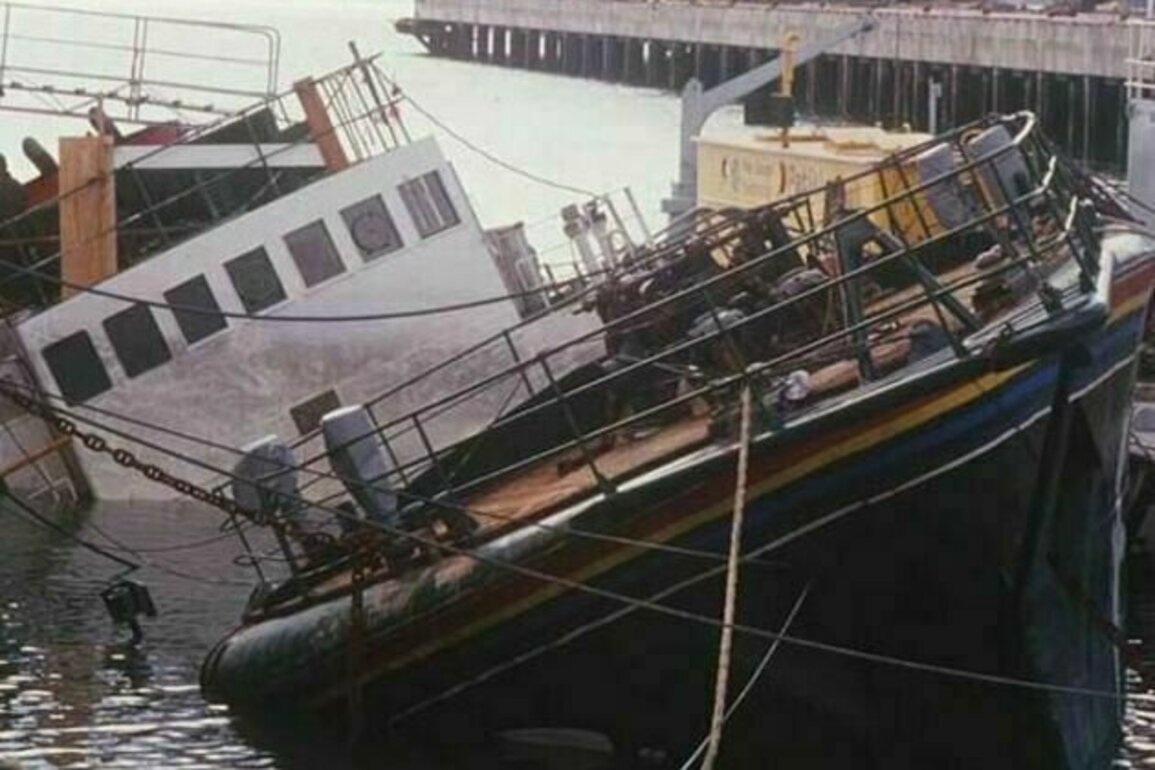
FORTY YEARS AGO this week, the quiet of Auckland Harbour was shattered when a bomb placed by French security agents sank Greenpeaces flagship, theRainbow Warrior.
This act of murder was a state terror response to sustained non-violent criticism from across the Pacific over France's nuclear weapons program and continuing colonial impact and legacy.
Four decades later, a new Pacific civil society initiative has emerged calling on France to pay its dues to the Pacific.
Rainbow Warrior continues Greenpeace's quest for climate justiceThe latest Greenpeace vessel bearing the Rainbow Warrior name has arrived in Vanuatu to aid in bringing climate change to the International Court of Justice.
Convened by Pacific advocates, including the Suva basedPacific Network on Globalisation, to coincide with the French sponsored United Nations Ocean Conference (UNOC) held in Nice last month, around 80 organisations representing millions of people from across the Pacific issued a joint civil society statement acknowledging the importance of urgent climate action and ocean protection through the UNOC process, butdeclaring that:
Since the late 1980s, France has worked to build on diplomatic, development and defence fronts to garner support from Pacific governments. This includes development assistance through the Agence Franaise de Dveloppement (AFD), Asian Development Fund (ADF), language and cultural exchanges, scientific collaboration and humanitarian assistance.
A strong diplomatic presence in Pacific capitals as well as a full schedule of high-level exchanges, including a triennialFrance-Oceania Leaders Summitcommencing in 2003, together function to enhance proximity with and inclination towards Paris sentiments and priorities.
The nuclear testing revival: Global fallout with deadly consequencesThe push to restart U.S. nuclear testing raises fears of global fallout, echoing a dangerous past with lasting consequences
French leadership at this UNOC process is once again central to its ongoing efforts to rebrand itself as a global leader on climate action, a champion of ocean protection and a promoter of sovereignty.
Nothing can be further from the truth.
The reality is that France is rather more interested in strengthening its position as a middle power in an Indo-Pacific rather than a Pacific framework, and as a balancing power within the context of big-power rivalry between the U.S. and China, all of which undermines rather than enhances Pacific sovereignty.
And, our leaders must not allow France to build this new global image on the foundations of its atrocities against Pacific peoples and our ocean continent.
Pacific civil society, therefore, calls on France:
- for immediate and irreversible commitments and practical steps to bring its colonial presence in the Pacific to an end before the conclusion, in 2030, of the Fourth International Decade on the Eradication of Colonialism; and
- to acknowledge and take responsibility for the oceanic and human harms caused by 30 years of nuclear violence in Maohi NuiFrench Polynesia, and to commit to full and just reparations, including support for affected communities, environmental remediation of test sites, and full public disclosure of all health and contamination data.
From Jakarta to the Vatican, Prime Minister Albanese's journey underscores a global call to ban the world's most destructive weapons.
We further call on Pacific Leaders to:
- keep France accountable for its multiple and longstanding debt to Pacific people; and
- ensure that Maohi Nui-French Polynesia and Kanaky-New Caledonia remain on the UN list of non-self-governing territories to be decolonised (UN decolonisation list).
Pacific leaders must ensure that France does not succeed in laundering its soiled linen, soiled by the blood of thousands of Pacific Islanders who resisted colonial occupation and/or who were used as test subjects for its industrial-military machinery, in the UNOC process.
Against a global backdrop of rising global nuclear tensions and concerns, the Pacific statement is a reminder of the extensive and intergenerational stories of nuclear dangers and deceit. And of the continuity of community struggle and action for justice, the arc may bend slowly, but it is bending, rainbow-hued and unsinkable.
As we move towards another 12 July Bastille Day and a national celebration of liberty, equality and fraternity, the calls for France to walk the talk in the Pacific remain constant and compelling.
Note: the full statement and further background to the renewed push for recognition and justice can be seenhere.
Dave Sweeneyis theAustralian Conservation Foundation'snuclear-free campaigner and was a founding member ofICAN. You can follow him@nukedavesweeney.
Related Articles
- Nukes don't stop war, they just raise the stakes
- Treaty the planets best chance to get rid of its worst weapons
- Nuclear deterrence is a dangerous fraud
- The Oppenheimer imperative: Normalising atomic terror
- U.S. slammed for decrying Australia's anti-nuke stance